Faith News
A message from St George parish church
Trees: an extended study of the significance of trees in the Bible.
Introduction.
When God creates all things good for human beings, a specific tree is mentioned: the Tree of Life (Gen 2. 9). It is put in the middle of the Garden of Eden: this garden planted by God (Gen 2. 8).
At the pivot point in the history of humanity is the Tree of the Cross, the life-giving tree.
History comes to an end as the Tree of Life is again mentioned. At the very end of time, it flourishes, perhaps as a group of trees, on both sides of the River of the Water of Life which flows from the Throne of God (Rev 22. 1 – 3). This is in the Holy City of the New Creation.
All through the Bible there is mention of trees and they are often used in familiar stories and events, in poetry and prophesy. They play a part in the story of redemption. In this set of reflections various aspects of trees (some admittedly fairly tenuous) will be examined. Hopefully this will lead to further thought or investigation on the part of the reader.
In general a chronological or historical approach will be used but some freedom and flexibility may also be applied if deemed appropriate or expedient.
This theme has been chosen to take us through the Trinity season because the liturgical colour for this season is green, evoking thoughts of new life, flourishing and hope.
Pomegranate
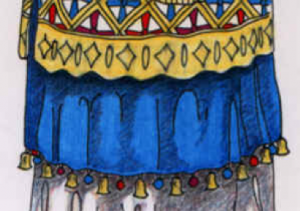
‘A bell and a pomegranate all round the lower hem of the robe for ministering’ [Ex 39. 26]
While travelling from Egypt to the Promised Land, the Tent of Meeting which housed the Ark of the Covenant travelled with the people. Aaron, Moses’ brother, and his sons are to be priests of the Tent of Meeting and they are to wear special clothes. The vestments consist of ‘a breastplate, an ephod, a robe, a chequered tunic, a turban and a sash’ [Ex 28. 4].Detailed instructions are given for the construction of these vestments. Around the lower hem of the ephod there are to be embroidered ‘pomegranates of blue, purple and crimson yarn … with bells of gold between them’ [Ex 28. 33; 39. 24 – 26].
When the people near the Promised Land, Moses sends out spies to reconnoitre the land to see what it offers and who is there. They had been in the wilderness for many years and they had been complaining: ‘it is no place for grain, or figs, or vines, or pomegranates and there is no water to drink’ [Num 20. 5].The spies return with both bad and good news. The people living there are powerful but the land is fertile. They brought back clusters of grapes and pomegranates and figs [Num 13. 23; Deut 8. 8].
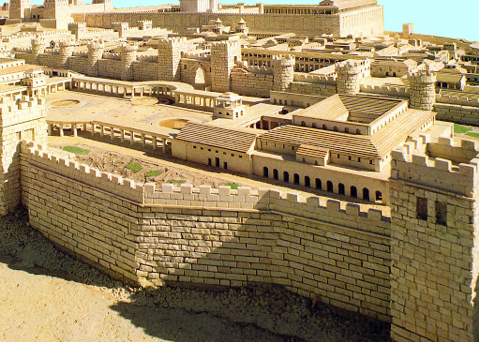
Later, when they settled, Solomon built a Temple to replace the Tent of Meeting. This is a massive building and pillars are used to hold up the structure. The pillars are decorated with pomegranates [1 Kings 7. 18, 42; 2 Chron 3. 16; 4. 13; Jer 52. 22 – 23].
Because of their many seeds pomegranates are a symbol of fertility. Some say that this may be the fruit that Adam and Eve ate in the Garden. Others think it is the fig. In the south aisle of St George’s Church in the “Confirmation” window (nearest the main door) pomegranates are hidden in the decorations at the top of the window.

The Song of Songs uses pomegranates
to describe the cheeks of the Beloved [SS 4. 3; 6. 7]
and the juice as an offering of love [SS 8.2].
Heavenly Father
may we grow in grace
so that every aspect of our lives may be more fruitful:
may we be generous in helping others,
caring of those in need,
engaged in action for justice
and thankful for all the graces you so freely give;
through our Lord Jesus Christ.
Amen.