Faith News
A message from St George parish church
The Gift of a Child
Introduction
The importance of children
In the ancient world if a person becomes significant or important to a belief system then it is assumed that he(usually) must have had some kind of miraculous or special birth (eg Marduk, Horus, Zoroaster, Athena, Alexander, Sargon, Krishna, Buddha, Huitzilopochtli …). This may not involve both a father and a mother.
In the Hebrew Scriptures the first woman, Eve (Havvah), is named the mother of all who live [Genesis 3. 20]. In that culture a woman’s value was often measured by her ability to produce children. If a couple fail to produce offspring it is regarded as the fault of the woman. She will have to endure the stigma associated with childlessness. In a patriarchal society women are required to comply with their husband’s wishes, remain silent and keep out of sight in the tent.
A man could take several wives and could also use concubines to provide him with children if necessary. Sons were needed to preserve the family line, property and identity, the family name. Children are a blessing [Gen 1.28; 12. 2 – 3; Deuteronomy 7.14; Psalm 27. 3; Ps 28].
At this time of year we begin to look towards the birth of Jesus and so inevitably Mary and Joseph are key characters in this momentous event in time. Other couples through the Hebrew Scriptures and the times just before this birth set various scenes that can help us to understand Mary’s and Joseph’s role and involvement.
There continues to be a significant physical, mental, and emotional investment in building a family today and, for some, a child is the visible evidence of success and worth.
In this series of four studies we will consider the gift of a child to couples in the Hebrew Scriptures and the beginning of the New Testament. Some of the fathers are noteworthy characters. The mothers are women of strength, honour and integrity: feisty and not afraid to buck tradition and the requirements of society. They speak and act in ways that conscience tells them are appropriate in order to protect their children.
Advent Week 1
The parents are too old and one or both are infertile
Sons are indeed a heritage from the Lord, the fruit of the womb a reward. [Ps 127. 3]
(i) Abram, Sarai and Isaac
The first few chapters of Genesis are littered with fertility. Following the command to ‘be fruitful and multiply’ [Gen 1. 28] descendants are listed in endless genealogies. But when the descendants of Terah, Abram’s father, are listed the line ends with: ‘Now Sarai was barren; she had no child’ [Gen 11. 30]. This has not been the case for any woman previously. Childlessness is seen in that culture as a disgrace for the wife and a disaster for the husband.
But, as Abram travels under God’s directions, there is a change of mood. The Lord indicates that a land will be given to Abram’s descendants, even though as yet he has none. Travelling with him is his wife, Sarai. Abram cares about her: he protects her from harm during a time of famine [Gen 12. 10 – 20]. Later Abram questions God about this untenable situation: he is to be the father of a great nation but he has no children.
Sarai says that it is God who has prevented her from bearing children [Gen 16.2.]. She feels inadequate and incomplete without a child but she selflessly suggests that perhaps the promise to Abram will be fulfilled through her slave-girl, Hagar [Gen 16. 1 – 2]. However, when Hagar conceives [Gen 16.15] Sarai again feels discontented and now vulnerable even though Hagar could not have the status of a wife. Meanwhile this perhaps solves the problem of an heir for Abram.
Then, at a critical moment, as Abram and Sarai are getting very old, God speaks to Abram changing his name to Abraham, telling him that Sarai is to be called Sarah and that she will be blessed and will give him a son. Abraham, laughing in amazement, responds, ‘Can a child be born to a man who is a hundred years old? Can Sarah, who is ninety years old, bear a child?’ [Gen 17. 17]. Now Sarah is key to the promise. Without her the covenant cannot be fulfilled.
The couple are visited by three strangers, who may be angels, God’s messengers. Sarah hovers in the background, in the door of the tent, and overhears the message once again: she is to have a child and she also laughs. Despite their doubts, Isaac, whose name means laughter or joy, is born [Gen 21. 6]. God emphasises that Isaac will be the true heir [Gen 21. 12].
God’s will is done despite the apparently poor odds.
What joy there is when a child is born, 
especially if it has been hoped for over many years.
(ii) Zechariah, Elizabeth and John
In Jerusalem Elizabeth finds herself in a similar position to Sarah: childless. Zechariah and Elizabeth, like Abraham and Sarah, are past child bearing age. While both Zechariah and Elizabeth are now older and it is Elizabeth who is described as barren, it is possible that both are infertile. This childlessness is a puzzle to them and their friends because the couple are described as ‘righteous before God, living blamelessly according to all the commandments and regulations of the Lord’ [Luke 1. 6] and yet they are not blessed with children. How can they deserve what was seen as a punishment? Many couples today do not understand why they cannot conceive and, in their confusion, may begin to blame one another. Friends and relatives may look at them and make judgements.
It is to Zechariah that the angel Gabriel appears. He is terrified. Gabriel reassures him and tells him that Elizabeth will have a son, who shall be called John [Luke 1. 13]. The child is to never to ‘drink wine or strong drink’ [Luke 1. 15]: he is to be consecrated as a Nazirite (more about this when we look at Samson in week 3). Because he doubts, Zechariah is struck speechless. Elizabeth conceives and she expresses her joy: the Lord ‘looked favourably on me and took away the disgrace I have endured among my people’ [Luke 1. 25]. When the boy is born the neighbours rejoice with her: ‘the Lord had shown his great mercy to her’ [Luke 1. 58]. Everybody is thrilled: they could see that ‘the hand of the Lord was with him(the baby)’ [Luke 1. 66].
A baby boy was not necessarily named after his father at this time but the name, John, chosen for this boy, means God has shown favour. This emphasises the removal of Elizabeth’s disgrace in being barren. Although Zechariah has been told the name of the baby, it is Elizabeth who pronounces it: ‘No; he is to be called John’ [Luke 1. 60]. Zechariah confirms her statement and then his tongue is released and he praises God. This child ‘will go before the Lord to prepare his ways’ [Luke 1. 76].
God has a purpose for every person: sometimes it is hard and leads to persecution and an early death. How distressed must these parents have been when, after calling many to repentance, John gets entangled in the insecurities of Herod who is responsible for John’s beheading [Mark 6. 27].
Let us pray for those who long for a child but cannot conceive
and for scientists and medics working to help them.
God of grace be close to those who are anxious, sad,
still hopeful, but frustrated and distressed
when their longed for conception of a child fails to happen. 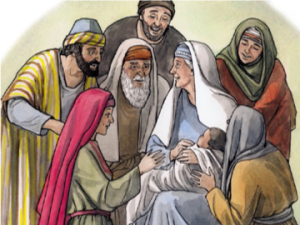
Support them in their relationship, guide their choices,
and give wisdom to those that advise them.
Amen, come, Lord Jesus!