Community
Taster Tour of St George’s Church in six episodes….week 3
Introduction
We hope you enjoy this mini taster tour in 6 instalments over the summer of 2024.
Everyone is welcome to visit St George’s – the church and its surroundings.
The building is open on weekdays: 9.00am – 1.00pm.
Do come and spend some time exploring. Experience the atmosphere, look at the many interesting items
and have some quiet time. There is usually someone available to listen or to answer questions.
Here is a link to information about Guided Tours
Week 3 – from Monday 12 August
Explore further
Near the front of the church you can see a large brass book stand called the lectern. During services it holds the Bible on the wings of an eagle. The symbolism of the eagle is uncertain but it was believed to be the bird that flew highest in the sky and was therefore closest to heaven. It carries the word of God to the whole world. The eagle also signifies strength, power and speed, hovering and guarding.
Opposite the lectern is the pulpit. To enable everyone to see and hear clearly, the pulpit raises the preacher or teacher above floor level. On the wall behind it is a crucifix which was made in Oberammergau. Hanging from it is a fall (piece of decorative material) and the colour of the fall indicates the season of the church’s year.
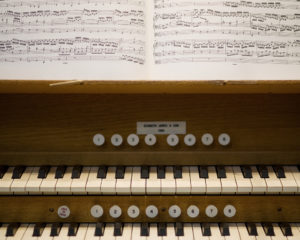
Looking towards the front of the church the organ can be seen. The pipes are opposite the keyboards and stops. The first mention of an organ at St George’s is in the minutes of a meeting of parishioners in 1843 when funds were to be raised to provide an organ. In 1887 a new organ built by Foster and Andrews was installed. It was blown by two motors fitted by Watkins and Watson. Various improvements have been made over the years and the present fine four manual organ was rebuilt in 1984. It is used at church services and at recitals and concerts. The Director of Music must be consulted before permission to use the organ is given.
In the same area, called the chancel, are the choir stalls [seats]. The choir leads the singing in services. Look at the ceiling to see the musical instruments painted there.
Further east is the Sanctuary where you can see the altar and the star covered ceiling. The sanctuary is a distinct area set apart for the Altar used during the celebration of the Eucharist. The tall candlesticks were designed by Thomas Freeth [see week 6] as was the cross on the east wall behind the altar.