Faith News
A message from St George parish church
All God’s Creatures
Introduction
Last year I presented a series on the trees of the Bible which ran all through the season of Trinity or Ordinary Time. This year we will engage with the members of the animal kingdom that appear in the Bible.
In this occasional series I may suggest that you to do some additional reading and investigation for yourself and I may not use the most obvious texts.
The list of animals in the account of Creation in Genesis chapter 1 is very familiar but there are other descriptions of creation in different books of the Bible and many more animals appear throughout the text. I will take a very broad approach including living creatures from smallest to largest; virus and gnat to elephant and whale; vertebrates and invertebrates; and various borderline cases. Texts are from the New Revised Standard Version, Anglicized Edition, with the Apocrypha and Deutero Canonical Books. The collection of animals included in this series is not exhaustive and the names for some creatures may differ in other translations.
Do take some time to look at our creation window: the great west rose window in St George’s.
Consider the variety and beauty of the creatures depicted there.
In the song of praise sung by the three young men, Hananiah, Mishael and Azariah, who were thrown into the burning fiery furnace we find:
The three with one voice praised and glorified and blessed God in the furnace:
“Blessed are you, O Lord, God of our ancestors,
and to be praised and highly exalted for ever.
…
Bless the Lord, you whales and all that swim in the waters;
sing praise to him and highly exalt him for ever.
Bless the Lord, all birds of the air;
sing praise to him and highly exalt him for ever.
Bless the Lord, all wild animals and cattle;
sing praise to him and highly exalt him for ever.
…
All who worship the Lord, bless the God of gods,
Sing praise to him and give thanks to him,
For his mercy endures for ever.
[Prayer of Azariah. 28, 29, 57 – 59, 68 (Apocrypha)]
Fish
We looked at some of the animals that feature in the plagues of Egypt in an earlier reflection (3 – 21.06.2021). After the water of the Nile turned to blood the fish in the Nile died [Ex 7. 17 – 18]. This was a disaster because fish were plentiful in the Nile and a major source of food for the Egyptians.
A fish plays a part in the story of Tobit and his son Tobias. We have already heard that a dog accompanied Tobias on his journey and that an angel travelled with him. On the first evening of the journey they camped near the river Tigris. ‘Suddenly a large fish leapt up from the water’ [Tob 6. 3]. The angel told Tobias to catch hold of the fish and explained how parts of it would be useful medicinally [Tob 6. 7 – 9]. The use of the gall is particularly pertinent because, as we discovered in the reflection on birds, the droppings of sparrows had made Tobit lose his sight [Tob2. 10]. When Tobias marries Sarah, they are protected from the demon that killed all Sarah’s previous husbands on the wedding night by the smell emitted when Tobias burned the liver and heart of the fish [Tob 8. 2 – 3]. When they return home Tobias is able to restore his father’s sight by smearing ‘the gall of the fish on his eyes’ [Tob 11. 8]. Why not read the whole story.
Possibly the most famous fish of the Hebrew Scriptures, is the ‘large fish’ [Jonah 1. 17]. This creature was more likely a whale and so a mammal and not a fish. Jonah had tried to disobey God and avoid the mission he was given but when he finds himself in dire straits Jonah remembers and prays. In his prayer to God, Jonah likens being in the belly of the fish to being in Sheol, the place of waiting after death [Jonah 2. 2], being in the deep waters. This is a description of danger, the Pit, a place of destruction or where a person is forgotten [Jonah 2. 5 – 6]. He is near death but Jonah prays expressing his trust in God and ‘the Lord spoke to the fish, and it spewed Jonah out upon the dry land’ [Jonah 2. 10].
The first followers of Jesus were fishermen [Mat 4. 18 – 2]. When they were called by Jesus to follow him, Jesus told Simon Peter and his brother Andrew that he would make them ‘fish for people’ [Mat 4. 19]. In Jesus time fish was a significant food item. The boy offering his lunch to the disciples had five loaves of bread and two fish [Mat 14. 17]. Jesus found a coin for the Temple tax for himself and his disciples by sending the disciples to catch a fish which had a coin in its mouth [Mat 17. 27]. After the resurrection Jesus appeared to his disciples and ate a piece of fish that they had prepared [Luke 24. 42 – 43]. On another occasion he stood upon the shore of the sea of Tiberias and, when they had caught nothing all night, instructed the disciples to throw their nets over the right side of the boat. 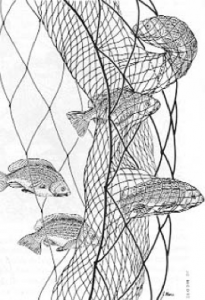 They caught ‘a hundred and fifty three’ [John 21. 11] fish on that occasion. Jesus himself had a charcoal fire ready to cook the fish for breakfast.
Blessed are you, O Lord our God,
Maker of all living creatures:
fish in the sea, birds in the air,
and animals on the land.
May we always praise you
for all your beauty in creation.
Blessed are you, O Lord our God,
in all your creatures.
Amen