Community
The Gift of a Child by Joan Conway
Introduction
The importance of children
In the ancient world if a person becomes significant or important to a belief system then it is assumed that he(usually) must have had some kind of miraculous or special birth (eg Marduk, Horus, Zoroaster, Athena, Alexander, Sargon, Krishna, Buddha, Huitzilopochtli …). This may not involve both a father and a mother.
In the Hebrew Scriptures the first woman, Eve (Havvah), is named the mother of all who live [Genesis 3. 20]. In that culture a woman’s value was often measured by her ability to produce children. If a couple fail to produce offspring it is regarded as the fault of the woman. She will have to endure the stigma associated with childlessness. In a patriarchal society women are required to comply with their husband’s wishes, remain silent and keep out of sight in the tent.
A man could take several wives and could also use concubines to provide him with children if necessary. Sons were needed to preserve the family line, property and identity, the family name. Children are a blessing [Gen 1.28; 12. 2 – 3; Deuteronomy 7.14; Psalm 27. 3; Ps 28].
At this time of year we begin to look towards the birth of Jesus and so inevitably Mary and Joseph are key characters in this momentous event in time. Other couples through the Hebrew Scriptures and the times just before this birth set various scenes that can help us to understand Mary’s and Joseph’s role and involvement.
There continues to be a significant physical, mental, and emotional investment in building a family today and, for some, a child is the visible evidence of success and worth.
In this series of four studies we will consider the gift of a child to couples in the Hebrew Scriptures and the beginning of the New Testament. Some of the fathers are noteworthy characters. The mothers are women of strength, honour and integrity: feisty and not afraid to buck tradition and the requirements of society. They speak and act in ways that conscience tells them are appropriate in order to protect their children.
Advent week 4
Life and Death
The steadfast love of the Lord never ceases. [Lamentations 3. 22]
(i) The couple from Shunem and their son
Elisha, the prophet who followed Elijah, was travelling around the country when he stopped at Shunem. He passed here regularly. As was the custom, he was offered hospitality, in this case by a wealthy woman and her older husband. As well as providing food they built a loft and furnished it so that whenever Elisha was in the vicinity he could stay there in comfort. Elisha wishes to reward her but she says she does not need anything. She is quiet, dignified and unassuming.
However, Gehazi, Elisha’s servant, has noticed that, although the couple have been married for several years, they have no children. When Elisha tells the woman that in a year’s time she will be cuddling a son [2 Kings 4. 16], she is sceptical. But Elisha’s promise is fulfilled and the child is born. The woman had provided, unasked, for Elisha’s material needs, he responds by promising the gift of a child, giving her social status and her husband an heir.
When the boy is old enough his father takes him out to the fields. Unfortunately he becomes ill: ‘My head hurts’ [2 Kin 4. 19] (or in the Hebrew ‘My head, my head’). He is taken home to his mother and she cradles him until he dies. She then takes him up to the loft room and puts him on the prophet’s bed. She does not weep or prepare him for burial: what is she expecting? Without telling her husband that the boy has died, she decides to find Elisha and challenge him: his promise has failed. Determined to confront Elisha, she orders a donkey to be saddled and rides off to find him. Elisha has promised the child so Elisha must be held accountable for his death. Here is a strong, independent woman.
Elisha sees her coming and sends a messenger to ask, ‘Are you all right?’ [2 Kin 4. 26]: you, your husband, the child. The woman defies convention, confronts Elisha and makes her case against him as having deceived her. Elisha understands her distress and sends Gehazi with Elisha’s staff back to the home telling him to lay the staff ‘on the face of the child’ [2 Kin 4. 31]. But this mother insists that Elisha take responsibility and return home with her. The staff is of no avail but when Elisha, alone with the boy, lies on him and prays the boy revives. When the mother enters she bows down in gratitude. The boy continues his life and we assume that he eventually dies a natural death.
This mother refused to believe that her son could be dead: Elisha had promised her a child; she had trusted him as a prophet of God. As a result of her perseverance, courage and refusal to be thwarted, she has been vindicated.

(ii) Mary, Joseph and Jesus
In the story of the establishment of this family there are echoes of many of the accounts of the families on which we have already reflected. These proleptic episodes give some insights but there are also some significant differences.
The baby to be born to Mary will be her first born, like Sarah, Elizabeth, Hannah, Manoah’s wife and the Shunamite woman. However Mary is young and there is no evidence that she might be unable to have a child. It is assumed that Joseph did not have any previous children so he differs from Abram, Elkanah and Amram. Neither Mary nor Joseph has had any need to request that God blesses them with a child.
Both Mary and Joseph are visited by an angel and, while Mary asks for information, neither questions their part in God’s plan [Luke 1. 26 – 38; Matthew 1. 18 – 25] nor shows any disbelief like Sarah, Abraham and Zechariah.
The child, Jesus, has a miraculous conception and strange birth circumstances indicating that he is chosen for a special role but his vocation, not only surpasses that of the others we have thought about, it is unique. He is unlike all prior humans: he is the Son of God. This is confirmed by Simeon [Luke 2. 29 – 35].
Once born it is necessary that Jesus is protected from harm and so, as in the case of Moses, he is hidden while many other children die. Like Pharaoh, Herod is more concerned with political consequences rather than of the religious impact of this birth. This situation is dangerous for Jesus. Both parents show strength of character and determination as they leave their own country in order to save this child.
Later the family return and Jesus grows and develops under the influence of his earthly parents. Joseph, as foster father, who, in the accounts, never speaks, shows all the concern of any good parent, biological or otherwise. When Jesus is older and the family are on the return journey from the pilgrimage to Jerusalem and Jesus is left behind both parents are worried and hurry back to find him. Those who take on the care of children not biologically related to them are following the example of Joseph and are able to fulfil their duties as parents with love.
As his ministry develops, Jesus begins to separate from and, in some ways, be lost to his family. During the pilgrimage to Jerusalem for Passover he announces ‘I must be in my Father’s house’ [Luke 2. 49]. Following the pattern of Moses and Samuel, Jesus has to follow God’s plan for his life. During his ministry this estrangement becomes clearer when he asks ‘Who is my mother and who are my brothers?’ [Mat 12. 48]. While we do not hear much more about Joseph, Mary follows the events and progress of Jesus’ life and is present at his death. Good parents learn how to moderate their influence over their children and trust them to make their own decisions, while always remaining available in the background.
Like Elizabeth’s and Zechariah’s son, John, Jesus is destined to die an early and violent death. Parents may also be called upon to witness terminal illness and the death of their son or daughter. Some are faced with the sudden death of their precious youngster by violence or accident. This is devastating since parents always assume that they will die before their child. They cannot find any sense, reason or purpose in these tragic situations.
But Jesus’ death is followed by resurrection: God raises him from the dead. This is a unique event: Jesus is the Son of God. Parents may be comforted by faith and the conviction that ‘we know that Christ, being raised from the dead, will never die again: death no longer has dominion over him’ [Romans 6. 9].
The meaning of these events is clarified and made understandable for the disciples living at that time and for us now: ‘beginning with Moses and all the prophets, Jesus interpreted to them all the things about himself in the scriptures’ [Luke 24. 27].
Let us pray for parents whose child has died 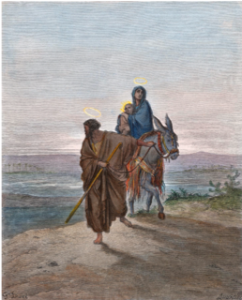
from illness, by accident, or by violence,
for ministers of religion, funeral directors
and bereavement counsellors
Creator God you make all lovely things
and bring joy and happiness
through the gift of children and in family life.
We cannot understand why this may suddenly be shattered.
Hold in your strong arms those
who have experienced the unexpected loss of a child.
Give strength to all who offer care to such families
that they may be effective in their ministry.
Amen, come, Lord Jesus!