Faith News
A message from St George parish church
Trees: an extended study of the significance of trees in the Bible.
Introduction.
When God creates all things good for human beings, a specific tree is mentioned: the Tree of Life (Gen 2. 9). It is put in the middle of the Garden of Eden: this garden planted by God (Gen 2. 8).
At the pivot point in the history of humanity is the Tree of the Cross, the life-giving tree.
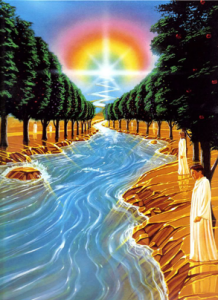
History comes to an end as the Tree of Life is again mentioned. At the very end of time, it flourishes, perhaps as a group of trees, on both sides of the River of the Water of Life which flows from the Throne of God (Rev 22. 1 – 3). This is in the Holy City of the New Creation.
All through the Bible there is mention of trees and they are often used in familiar stories and events, in poetry and prophesy. They play a part in the story of redemption. In this set of reflections various aspects of trees (some admittedly fairly tenuous) will be examined. Hopefully this will lead to further thought or investigation on the part of the reader.
In general a chronological or historical approach will be used but some freedom and flexibility may also be applied if deemed appropriate or expedient.
This theme has been chosen to take us through the Trinity season because the liturgical colour for this season is green, evoking thoughts of new life, flourishing and hope.
Tree of life
‘To those who conquer God gives permission to eat from the tree of life’ [Rev 2. 7].
Ezekiel, in exile in Babylon, spoke of his vision of a river flowing from the throne of God. ‘I saw on the bank of the river a great many trees on one side and on the other. … Their leaves will not wither nor their fruit fail, but they will bear fresh fruit every month … their fruit will be for food and their leaves for healing’ [Ez 47. 7, 12]. Ezekiel was of the priestly family as well as being a prophet. At the beginning of his time of prophecy, there was still a hope of returning to Jerusalem and the Temple but later, when the Temple had been destroyed the hope was for a heavenly Jerusalem as described in this text.
The influence of Ezekiel can be seen in the last book of the Bible. In Revelation those who may enter the city are ‘ a great multitude that no one could count, from every nation, from all tribes and peoples and languages, standing before the throne and before the Lamb, robed in white, with palm branches in their hands’ [Rev 7. 9]. These are the ones ‘who wash their robes, … (and) they will have the right to the tree of life’ [Rev 22. 14]; they have conquered him (the accuser) by the blood of the Lamb’ [Rev 12. 11]. They praise God: ‘Father of majesty unbounded, your true and only Son, worthy of all praise, the Holy Spirit, advocate and guide’ [Te Deum].
Here in the last book of the Bible is the vision of the new creation, God’s provision of food and healing [Rev 22. 1 – 2] and God’s final victory. In the New Creation we come full circle and God’s purpose is fulfilled.
Heavenly Father,
grant that we, in the fullness of time,
may come to see the Tree of Life
in your holy city.