Faith News
A message from St George parish church
Trees: an extended study of the significance of trees in the Bible.
Introduction.
When God creates all things good for human beings, a specific tree is mentioned: the Tree of Life (Gen 2. 9). It is put in the middle of the Garden of Eden: this garden planted by God (Gen 2. 8).
At the pivot point in the history of humanity is the Tree of the Cross, the life-giving tree.
History comes to an end as the Tree of Life is again mentioned. At the very end of time, it flourishes, perhaps as a group of trees, on both sides of the River of the Water of Life which flows from the Throne of God (Rev 22. 1 – 3). This is in the Holy City of the New Creation.
All through the Bible there is mention of trees and they are often used in familiar stories and events, in poetry and prophesy. They play a part in the story of redemption. In this set of reflections various aspects of trees (some admittedly fairly tenuous) will be examined. Hopefully this will lead to further thought or investigation on the part of the reader.
In general a chronological or historical approach will be used but some freedom and flexibility may also be applied if deemed appropriate or expedient.
This theme has been chosen to take us through the Trinity season because the liturgical colour for this season is green, evoking thoughts of new life, flourishing and hope.
Wisdom: like a tree
‘Come to me, you who desire me, and eat your fill of my fruits’ [Sir 24. 19].
The book Sirach (Ecclesiasticus) was written about two hundred years before the birth of Jesus and is one of the deutero-canonical (second canon) texts. It is written in Greek and forms part of the Wisdom tradition. A collection, in poetic style, of sayings and poems, it includes advice on wisdom, poverty and riches, duty to God and parents, the keeping of the Law, justice, self-control, death and many other aspects of life. Towards the end it rehearses the merits of the patriarchs.
The nature and character of Lady Wisdom is particularly addressed in chapter 24. She ‘took root in an honoured people, in the portion of the Lord, his heritage’ [Sir 24. 12]. Lady Wisdom describes herself in term of well-known trees:
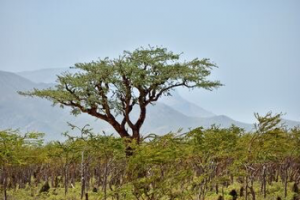
‘I grew tall like a cedar in Lebanon, and like a cypress on the heights of Hermon. I grew tall like a palm tree in Engedi and like rose-bushes in Jericho; like a fair olive tree in the field, and like a plane tree beside water I grew tall. Like cassia and camel’s thorn I gave forth perfume, and like a choice myrrh I spread my fragrance, like galbanum, onycha, and stacte, and like the odour of incense in the tent. Like a Terbinth I spread out my branches, and my branches are glorious and graceful. Like the vine I bud forth delights and my blossoms become glorious and abundant fruit’ [Sir 24. 13 – 18].
Here indeed is a wonderful summary of the worth, beauty, usefulness and value ascribed to trees. Many of them have already been mentioned in previous topics in this series.
O God, the well of life,
make us bright with wisdom,
that we may be lightened
with the knowledge of your glory
in the face of Jesus Christ our Lord.
Amen.