Faith News
A message from St George parish church
6 August – The Feast of the Transfiguration and the day on which the atomic bomb was dropped on Hiroshima, Japan.
The Feast of the Transfiguration
and the day on which the atomic bomb was dropped on Hiroshima, Japan.
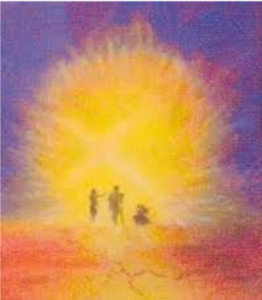
Pax Christi Scotland
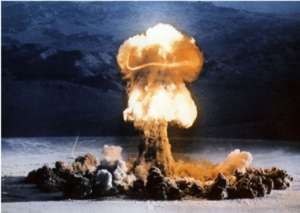
Science Photo Library
This reflection considers the coincidence of the date on which the Church celebrates the Transfiguration of Jesus (Matthew 17. 1 – 13; Mark 9. 2 – 13; Luke 9. 28 – 36) and on which the atomic bomb was dropped on Hiroshima. Transfiguration is a concept which may be used to describe or encompass both events.
Recently the eightieth anniversary of the D Day landings was celebrated but the end of the war in Europe was not achieved until VE Day, 8 May 1945. On the Pacific front the hostilities continued until 14 August 1945, VJ Day. While there are many theories concerning the effect of the action of dropping the bomb on 6 August 1945, it is not necessarily certain that this was the only or the deciding factor in the surrender of Japan.
Just before the Transfiguration Jesus had begun to explain to his disciples the way his ministry would end, but they did not want to understand. (Mat 16. 21 – 28; Mk 8.31 – 9. 1; Lk 9. 18 – 24). Even though Peter recognised Jesus as the Christ (Lk 9. 20) he did not want to hear the prediction Jesus made about his approaching death. In this world the forces of evil are working and victory over them will only come through suffering. Shortly after this Jesus, knowing that the end was near, ‘set his face to go to Jerusalem’ (Lk 9.51). The Transfiguration marked a turning point. Jesus has demonstrated his power through teaching, healing and miracles. This event is a climax and Jesus now begins his final journey to Jerusalem where he will suffer and die. There is no turning back. He moves purposely towards suffering and his death, which will overcome evil.
Previously Jesus has spoken of the end times: ’wars …nations shall rise against nation … earthquakes .. famines … plagues … fearful events …’ (Mt 24. Mk 13, Lk 21) and, although the day and hour will not be known to humanity (Mark 13. 32 – 33). In religion, in saga, in history and in science discontinuity has been a theme from the beginning of time, whatever that may mean. The discovery of the potential power that was hidden in atoms became the means of either harnessing it for the good of humanity or of using it for destruction and the transfiguring of a huge area of the planet. It also had an impact on the relationship between those who had the power and those who did not yet have it. The Manhattan Project is explored in the film Oppenheimer. For Christians, a different category of discontinuity occurs with the birth, death and resurrection of Jesus.
In the Gospels the placing of the event on the mountain indicates that this is a moment of revelation.
The physical manifestation of the mountain top experience of the Transfiguration is seen and heard:
the voice of God, the cloud and the dazzling white, whiter than bleach could achieve, of the clothes and face of Jesus.
The glory of God is seen in the transfiguration of Jesus. He is metamorphosed and seen in glory, radiance:
the white dazzling light of heaven.
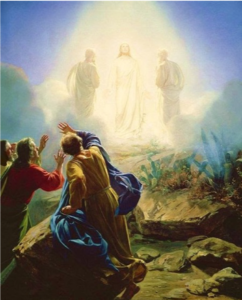
Wikimedia Carl Bloch (1834–1890) Creative Commons Attribution-ShareAlike 3.0 License
But where was God in the blazing flash of light, the fireball, the shock waves, the intense heat melting structures, the burning of vegetation and flesh and the mushroom cloud of Hiroshima?
Because the site was relatively flat the impact spread over a wide area.
Here was complete transformation through devastation and destruction.

Photo courtesy of the BBC
This bomb was a gun-type fission bomb using uranium. In the days following a further bomb was dropped on Nagasaki: an implosion bomb using plutonium. There were fewer casualties since Nagasaki is in a valley which restricted the damage. This obliteration was supposed to ensure surrender.
The vision on the mountain was a positive experience and one of the events that led to new life and the hope of life in its fullness for all who would receive it through the resurrection of Jesus. The aftermath of the bomb was not just immediate death for those present but long term illness and future problems which would negatively affect generations to come. The effects of radiation were unknown at that time and the test site was inadequate to show the real impact of the bomb since it was a desert area.
In both events the effects were not just physical but also psychological. For the disciples the voice is close and the cloud all around them. The message spoken is powerful. They see and hear and they drop to the ground in wonder and awe. At Hiroshima the sound, light and physical force of the explosion throws people to the ground burning in the radiance, deafening them and blinding them. The cloud remains above to manifest to the world
and to imprint on the memory what has been done.
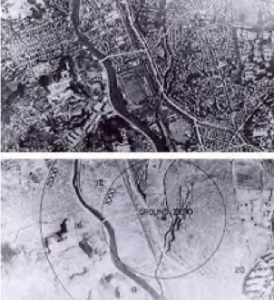
Before and After photo Photo courtesy of Atomic Heritage Foundation
This reminder is seen in the changed lives of those who survive.
Psychological problems affected not just those
who lived in and around Hiroshima
but also those who were involved before
in the manufacture and dropping of the bomb.
Families have been broken.
Genetic changes and markers continue.
The geographical area was destroyed after
and is now rebuilt but the name continues to carry
a significant warning and a feeling of fear.
Photo courtesy of Atomic Heritage Foundation
As a result of the mountain top transfiguration the reaction of the disciples is confusion, amazement,
awe and misinterpretation and they respond by suggesting action: the building of shelters for each of those seen.
They realise that this is not appropriate and they are warned to keep silent about what they have experienced.
After the initial destruction of Hiroshima there could not be silence but the discussion that followed has not always been rational or reasonable.The devastation and continuing impact caused by the bomb revived questions that had been asked before and during the development of the bomb: was the research useful; was the manufacture of such a destructive weapon necessary; was its use justified; who would make the decision to use it; what was really understood about its short term and long-term effects? These questions remain as conflicts continue around the world.
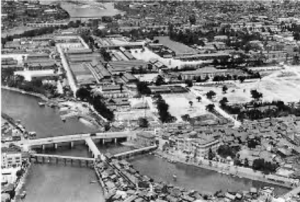
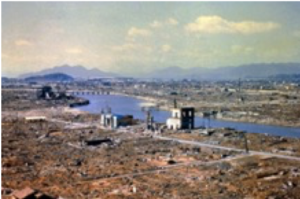
Photo courtesy of Mainchini Newspaper Photo courtesy of the BBC
The reasons given for the decision to drop the bomb are largely military rather than moral.
In deciding to drop the bomb the utilitarian view of the ends justifying the means was cited.
While many would be killed in one fell swoop there would be fewer casualties than if the war
was allowed to continue especially since the Russians appeared to be procrastinating on the China front.
At that time for Japan the principle was death before surrender for civilians as well as the military.
It would seem to be impossible for there to be any dialogue and, in retrospect, looking for other possible solutions provides few options. Following the precepts of the Just War it might be argued that Hiroshima was a largely industrial location and the numbers of innocent victims would be minimal but virtue ethics could be used
to counter both these arguments.
Immediately after the Transfiguration Jesus makes the decision to move towards his inevitable suffering and death.
He knows the consequences of his decision will be pain and suffering for him. He does not act out of a rational duty or requirement of his life but, for the sake of humanity, he takes this action willingly, knowing that his sacrifice is right, perfect and acceptable. The consequences of his act brings in a new age for humanity: it is a different category of victory.
Each leader can comment on and try to justify the decision taken and how knowledge held should be used. However the consequences and aftermath of the use of the bomb could not be known. The decision taken will remain the subject of controversy. The bomb initiated a radical change in the relationship between humans and creation and this continues to be with us. The event cannot be undone and the consequences and implications remain with us. The Transfiguration followed by the death and resurrection of Jesus also initiated a change in the relationship between humans and God. For Christians this age is the one in which salvation has come but also is still to come and the Kingdom is here but in human time we still wait for the day and hour which we cannot know. Decisions regarding the use of the means to destroy life or to enhance it remain our responsibility.
Bibliography
Commentaries:
C F Evans, Saint Luke, SCM Press, London (1990)
J C Fenton, Saint Matthew Penguin Books, London (1963)
D E Nineham, Saint Mark Penguin books, London (1992)

Other:
https://www.bbc.co.uk/iplayer/episode/m0021lrg/atomic-people
Alan Axelrod, The Complete Idiot’s Guide to American History, Alpha Books (2000) pp 242 – 258
Paul Ham, Hiroshima Nagasaki, Thomas Dunne Books, St Martins Press, New York (2007)
Max Hastings, Retribution, Alfred A Knop, New York (2008)
Wilson D Miscamble, The Most Controversial Decision, Cambridge University Press (2011)
Richard Rhodes, The Making of the Atom Bomb, Simon and Schuster, New York (1986)
Chris Wallace, Countdown 1945, Avid Reader Press, New York (2020)

For further reading - Library – under Dewey system number 940
Various websites