Faith News
A message from St George parish church
All God’s Creatures
Introduction
Last year I presented a series on the trees of the Bible which ran all through the season of Trinity or Ordinary Time. This year we will engage with the members of the animal kingdom that appear in the Bible.
In this occasional series I may suggest that you to do some additional reading and investigation for yourself and I may not use the most obvious texts.
The list of animals in the account of Creation in Genesis chapter 1 is very familiar but there are other descriptions of creation in different books of the Bible and many more animals appear throughout the text. I will take a very broad approach including living creatures from smallest to largest; virus and gnat to elephant and whale; vertebrates and invertebrates; and various borderline cases. Texts are from the New Revised Standard Version, Anglicized Edition, with the Apocrypha and Deutero Canonical Books. The collection of animals included in this series is not exhaustive and the names for some creatures may differ in other translations.
Do take some time to look at our creation window: the great west rose window in St George’s.
Consider the variety and beauty of the creatures depicted there.
In the song of praise sung by the three young men, Hananiah, Mishael and Azariah, who were thrown into the burning fiery furnace we find:
The three with one voice praised and glorified and blessed God in the furnace:
“Blessed are you, O Lord, God of our ancestors,
and to be praised and highly exalted for ever.
…
Bless the Lord, you whales and all that swim in the waters;
sing praise to him and highly exalt him for ever.
Bless the Lord, all birds of the air;
sing praise to him and highly exalt him for ever.
Bless the Lord, all wild animals and cattle;
sing praise to him and highly exalt him for ever.
…
All who worship the Lord, bless the God of gods,
Sing praise to him and give thanks to him,
For his mercy endures for ever.
[Prayer of Azariah. 28, 29, 57 – 59, 68 (Apocrypha)]
Domestic animals
There are so many references in the Bible to various domestic animals that only a few can be included in this reflection.
When they were a nomadic people, the Israelites kept animals that could be herded and controlled easily. Later, when they became settled, animals were kept not just for food but also for transport and for farming purposes. Additionally they were an indication of power and wealth: Nebuchadnezzar sent his general, Holofernes, to subdue rebellion with ‘a vast number of camels and donkeys and mules for transport, and innumerable sheep and oxen and goats for food; also ample rations for everyone, and a huge amount of gold and silver from the royal palace’ [Judith 2. 17 – 18].
Adam’s son, Abel is the first recorded shepherd in the Bible: ‘Abel was a keeper of sheep’ [Gen 4. 2]. Later Abram uses domestic animals in the setting up of the covenant with God [Gen 15. 9].
Again in Genesis, Jacob, ever the cunning trickster, made a pact with his father-in-law, Laban. He managed to gain the strongest sheep and goats for his own flock by a clever breeding plan [Gen 30. 25 – 43]. It has been shown that the chemicals present in some trees of that area could affect the health of animals that consumed them. These chemical became dissolved in the water that the sheep drank. The genetic heritage of the sheep could also give rise to colour in the fleece, even if it was recessive. It was God who, though an angel in a dream, showed Jacob what to do [Gen 31. 1 – 11].
Jacob’s older sons were jealous of Joseph who seemed to be his father’s favourite. When they plotted against Joseph and sold him into slavery, it was the blood of a goat that they smeared on his coat to show to his father and pretend that Joseph had been killed by a wild animal [Gen 37. 28 – 32]. After his capture, Joseph is asked to interpret pharaoh’s dreams of cattle, fat or lean [Gen 41. 1 – 36]. Since he gives accurate interpretations he becomes a favourite of pharaoh. Daniel also has dreams involving cattle [Dan 4. 25; 8. 5 – 9].
Oxen feature in a bizarre image of what will happen to the people who refuse to make a treaty or surrender to king Saul who ‘took a yoke of oxen and cut them in pieces’ [1 Sam 11. 7] indicating that this will be the fate of anyone who tries to thwart him. In the time of king David, while transporting the Ark of the Covenant on an ox cart, a man tried to steady the ark when the oxen shook the cart. He died because he touched the ark. This did not seem fair to David but David became more fearful of God because of that event. [2 Sam 6. 6 – 9].
Jesus often used domestic animals to make a point: ‘if one of you has a child or an ox that has fallen into a well, will you not immediately pull it out on a Sabbath day?’ [Luke 14. 5]. Sheep and goats will be separated at the end times [Mat 25. 31 – 33]. In a parable Jesus tells of the good shepherd who will seek out even one missing sheep [Luke 15. 3 – 7] and he calls himself the good shepherd [John 10. 11- 16].
In the days of the Temple, annually, on the Day of Atonement a bull and two goats were brought to the Temple for sacrifice in atonement for the sins of the people [Lev16]. The bull and one of the goats were sacrificed. For the other goat, Aaron was to ‘lay both his hands on the head of the live goat, and confess over it all the iniquities of the people of Israel, and all their transgressions, all their sins, putting them on the head of the goat, and sending it away into the wilderness’ [Lev 16 21]. This is the “scapegoat”.
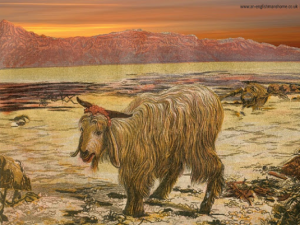
The Scapegoat by William Holman Hunt
But much more famous animal appears in the story of the Akedah, the Binding of Isaac. God asked Abraham to take his son and, on arrival at the place of sacrifice, told him to bind the boy in readiness to give him as a burnt sacrifice, Abraham was tested in the extreme. How could God keep his promise to make Abraham the father of a great nation, if God required the life of his only child? This is the beginning of the idea, taken up in Maccabees and Masada, that it might be necessary to surrender one’s life or that of a beloved child if required by faith or for truth, justice or freedom: martyrdom. For Abraham the ram [Gen 22. 13] makes this sacrifice unnecessary.
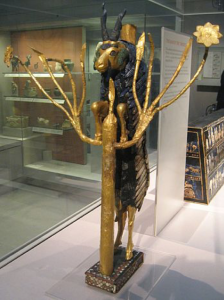
Ram in a Thicket as displayed in the British Museum
In the story of the escape of the Israelites from Egypt, the roasted sheep is an essential ingredient in the Passover meal [Ex12. 1 – 13]. Jesus is referred to in the Gospel of John as ‘the Lamb of God’ [John 1. 29, 36]. This title brings us back to Isaac, the sacrifice. While the word used for “lamb” is not the same as that used in Exodus, it may link the blood of the Lamb on the doorposts to tell the Lord to ‘pass over’ [Ex 12. 13] these homes and not kill the first-born. It was at the time of Passover that Jesus went to Jerusalem for his last meal with the disciples, which was followed by his death. While it was not the function of the paschal lamb to remove sin, the writer of this gospel interprets the phrase ‘Lamb of God’ as removing the sin of the world. Jesus accomplishes his redeeming work. St Paul proclaims: ‘For our paschal lamb, Christ, has been sacrificed. Therefore, let us celebrate the festival’
[1 Cor 5. 7, 8].
Blessed are you, O Lord our God,
Maker of all living creatures:
fish in the sea, birds in the air,
and animals on the land.
May we always praise you
for all your beauty in creation.
Blessed are you, O Lord our God,
in all your creatures.
Amen