Faith News
A message from St George parish church
All God’s Creatures
Introduction
Last year I presented a series on the trees of the Bible which ran all through the season of Trinity or Ordinary Time. This year we will engage with the members of the animal kingdom that appear in the Bible.
In this occasional series I may suggest that you to do some additional reading and investigation for yourself and I may not use the most obvious texts.
The list of animals in the account of Creation in Genesis chapter 1 is very familiar but there are other descriptions of creation in different books of the Bible and many more animals appear throughout the text. I will take a very broad approach including living creatures from smallest to largest; virus and gnat to elephant and whale; vertebrates and invertebrates; and various borderline cases. Texts are from the New Revised Standard Version, Anglicized Edition, with the Apocrypha and Deutero Canonical Books. The collection of animals included in this series is not exhaustive and the names for some creatures may differ in other translations.
Do take some time to look at our creation window: the great west rose window in St George’s.
Consider the variety and beauty of the creatures depicted there.
In the song of praise sung by the three young men, Hananiah, Mishael and Azariah, who were thrown into the burning fiery furnace we find:
The three with one voice praised and glorified and blessed God in the furnace:
“Blessed are you, O Lord, God of our ancestors,
and to be praised and highly exalted for ever.
…
Bless the Lord, you whales and all that swim in the waters;
sing praise to him and highly exalt him for ever.
Bless the Lord, all birds of the air;
sing praise to him and highly exalt him for ever.
Bless the Lord, all wild animals and cattle;
sing praise to him and highly exalt him for ever.
…
All who worship the Lord, bless the God of gods,
Sing praise to him and give thanks to him,
For his mercy endures for ever.
[Prayer of Azariah. 28, 29, 57 – 59, 68 (Apocrypha)]
Domestic birds
The birds chosen for this reflection may not be those we usually think of as domestic.
While birds do not figure highly in the diet of the Israelites, ‘fatted fowl’ [1 Kings 4.23] are included in a list of provisions for King Solomon. Birds are more often associated with sacrifices. For nomadic tribes it would be difficult to manage poultry, while herds of sheep and cattle are easier to control. However there is some evidence that birds such as quail, partridge, pigeons, doves and chickens and eggs were eaten if available. Later when the people became more settled there is evidence that pigeons and doves were kept in dovecotes carved in the rock.
A notable bird in the Jewish Scriptures is the quail because it was the bird that helped to feed the Israelites on their journey from Egypt to the Promised Land [Ex 16. 13; Num 11. 31; Ps 105. 40]. Quails migrate annually in large flocks from Arabia and other countries in that region, flying north towards the Red Sea. In this instance they were driven by a wind away from the sea and, after a long flight, when they were exhausted they landed and were easily caught.
Whether ostriches count as domestic animals may be debated but they are mentioned in Lamentations: ‘but my people has become cruel, like the ostriches in the wilderness’ [Lam 4. 3]. This so called cruelty may refer to the fact that ostriches lay their eggs on the surface of the ground, often on sand, and then appear to desert their eggs.
The partridge lives in the mountains [1 Sam 26.20]. When caught it is put in a cage and used as a decoy [Sirach 11.29 – 30]. This behaviour is an example and a warning to people to choose their friends carefully and not to be enticed into the snare of a crafty person. Peacocks were valued and formed part of the treasure and wealth of King Solomon [1 Kings 10. 22; 1 Chron 9. 21], although the translation is unclear, the word only appearing in 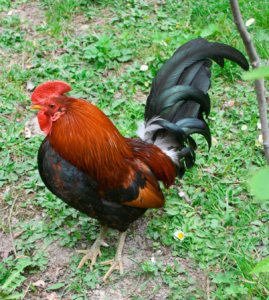 this context. The rooster is mentioned in Proverbs along with the lion, the he-goat and a king as a stately walker: ‘the strutting rooster’ [Prov 30.31].
In the New Testament the behaviour of a hen is described. Jesus laments, ‘Jerusalem, Jerusalem, the city that kills the prophets and stones those who are sent to it! How often have I desired together your children together as a hen gathers her brood under her wings, and you were not willing!’ [Mat 23. 37; Luke 13.34]. Possibly the most famous rooster or cock is the one who crows, at some time between midnight and 3.00am, after Peter denies Jesus [Mat 26. 34, 74; Mark 14. 30, 66 – 72; Luke 22. 34, 60, 61; John 13. 38; 18. 27].
Blessed are you, O Lord our God,
Maker of all living creatures:
fish in the sea, birds in the air,
and animals on the land.
May we always praise you
for all your beauty in creation.
Blessed are you, O Lord our God,
in all your creatures.
Amen