Faith News
A message from St George parish church
All God’s Creatures
Introduction
Last year I presented a series on the trees of the Bible which ran all through the season of Trinity or Ordinary Time. This year we will engage with the members of the animal kingdom that appear in the Bible.
In this occasional series I may suggest that you to do some additional reading and investigation for yourself and I may not use the most obvious texts.
The list of animals in the account of Creation in Genesis chapter 1 is very familiar but there are other descriptions of creation in different books of the Bible and many more animals appear throughout the text. I will take a very broad approach including living creatures from smallest to largest; virus and gnat to elephant and whale; vertebrates and invertebrates; and various borderline cases. Texts are from the New Revised Standard Version, Anglicized Edition, with the Apocrypha and Deutero Canonical Books. The collection of animals included in this series is not exhaustive and the names for some creatures may differ in other translations.
Do take some time to look at our creation window: the great west rose window in St George’s.
Consider the variety and beauty of the creatures depicted there.
In the song of praise sung by the three young men, Hananiah, Mishael and Azariah, who were thrown into the burning fiery furnace we find:
The three with one voice praised and glorified and blessed God in the furnace:
“Blessed are you, O Lord, God of our ancestors,
and to be praised and highly exalted for ever.
…
Bless the Lord, you whales and all that swim in the waters;
sing praise to him and highly exalt him for ever.
Bless the Lord, all birds of the air;
sing praise to him and highly exalt him for ever.
Bless the Lord, all wild animals and cattle;
sing praise to him and highly exalt him for ever.
…
All who worship the Lord, bless the God of gods,
Sing praise to him and give thanks to him,
For his mercy endures for ever.
[Prayer of Azariah. 28, 29, 57 – 59, 68 (Apocrypha)]
The plagues of Egypt
Several living creatures are mentioned in the plagues of Egypt (Exodus 7 – 11)
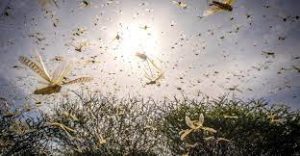
While in the first plague no living things are concerned as the water of the river Nile is turned to blood but many of the creatures living in or near the Nile must have been affected. Several of the other plagues did involve animals: frogs, lice, flies, livestock pestilence, locusts.
Pharaoh is warned each time and given the chance to let the people go. In these plagues the natural occurrences of the land of Egypt, such as swarms of flies or infections of cattle, are amplified. Their intensity is exceptional and Pharaoh is powerless to frustrate the purpose of God.
An additional significance of these particular plagues was that they involved the gods of Egypt. The river Nile was a god but as it turned to blood, instead of being the life of the surrounding area, it became the cause of the death of the fish. Frogs were a sign of fruitfulness but they became a horror and a cause of uncleanness, getting into everything in the home, until they died and rotted. The fourth plague involved flies or gnats and beetles.
The beetle or scarab was also sacred and was found on Egyptian tombs and amulets. The murrain which came upon all the cattle meant that they died and these beasts included sacred cattle: ram, goat, bull. When the locusts arrived all the green plants were eaten.
Thus God is shown as greater than all the gods of Egypt.
In the Wisdom of Solomon (Apocrypha) chapter 19, parts of the history of the people of Israel are recounted. The punishment of the enemies of the people of Israel includes being ‘killed by the bites of locusts and flies’ [Wis 16.9] but the Israelites were protected even from ‘the fangs of venomous serpents [Wis 16. 10]. The Egyptians still remember how ‘instead of producing animals the earth brought forth gnats, and instead of fish the river spewed out vast numbers of frogs’ [Wis 19. 10].
It is quite common in the Hebrew Bible to find accounts of important events recalled in several different places each with a distinctive purpose or emphasis.
Blessed are you, O Lord our God,
Maker of all living creatures:
fish in the sea, birds in the air, and animals on the land.
May we always praise you
for all your beauty in creation.
Blessed are you, O Lord our God, in all your creatures.
Amen